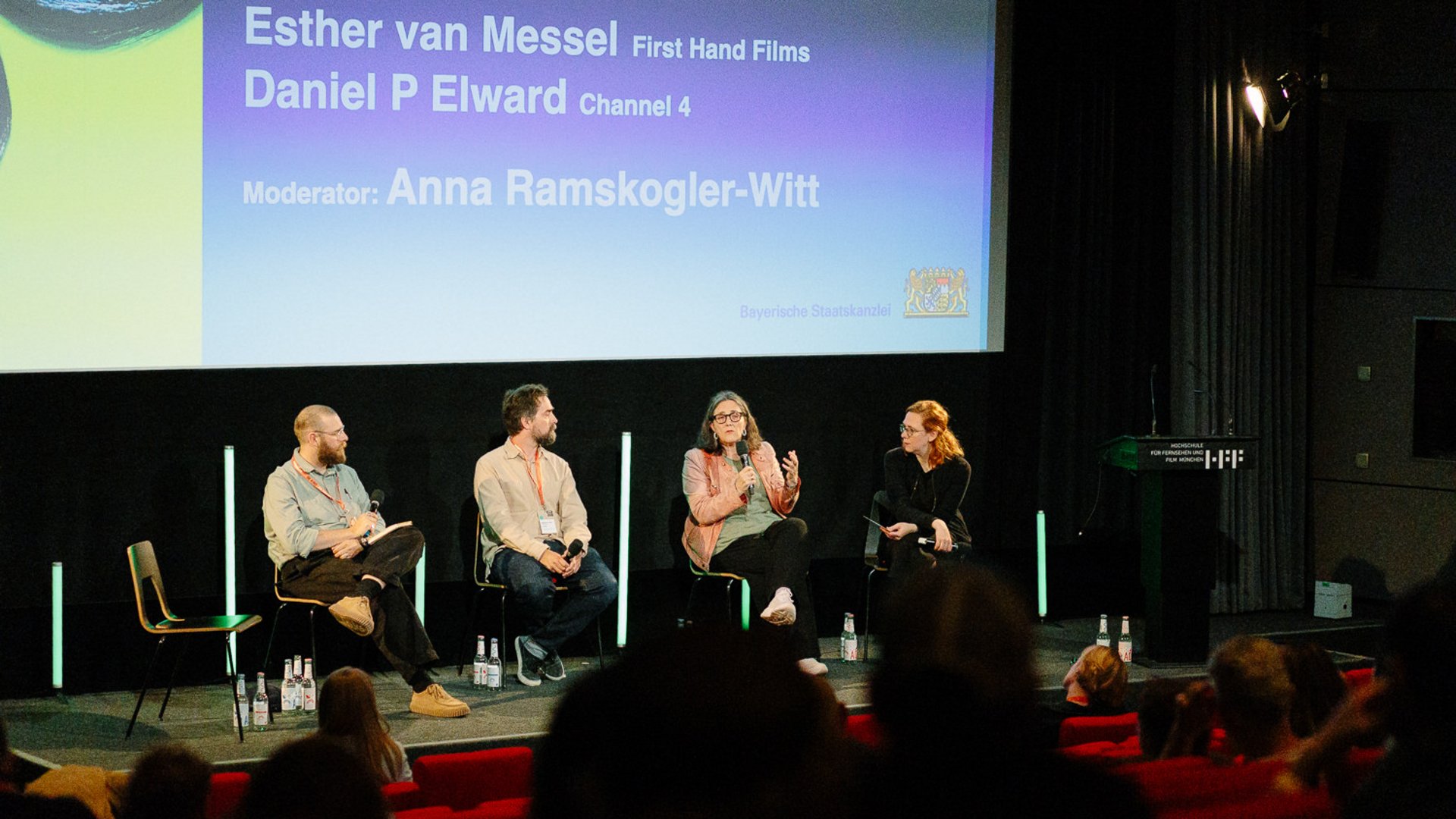
I love moderating panels that bring together people who rarely end up at the same table. “Beyond Linear: Connecting with Today’s Audiences” at DOK.fest Munich 2026 was one of those, hosted by the DCampus Exchange in cooperation with the DOK.forum.
Three worlds met on the panel: Daniel P. Elward from Channel 4 from a broadcaster’s perspective, Matthias Leitner from Bayerischer Rundfunk as a digital storyteller and format innovator, and Esther van Messel from First Hand Films from production and world sales. The question that connected them all: how do platforms, distributors and broadcasters actually build their audiences, where do their strategies converge, and where do they diverge?
What I enjoyed most about this conversation: in the end there were no nice platitudes, but concrete insights. Here are the ones that stayed with me.
- Understanding your audience does not mean giving in. Matthias Leitner (BR) put it perfectly: it is not about giving audiences what they want, but what we want to tell, in a form they enjoy watching. His team develops user-centric, builds cheap prototypes, tests early and quickly drops what does not work.
- Be as much an expert on your audience as on your topic. From day one, with real contact to your target group and “warm data,” not just assumptions about the algorithm. Often eight to twenty people in a test are enough.
- Trust is the real differentiator. Daniel Elward (Channel 4) was clear: on length, the first minutes and presentation, you can learn from creators and compromise. On trust, credibility and emotion, never.
- Title and thumbnail are your most important marketing tool. Esther van Messel (First Hand Films) says: imagine all that is left of your film is the title and a small picture. If you cannot look at your own story from the outside, find people who can, and trust them.
- You do not just upload a film to YouTube. YouTube is complex and constantly changing. Finding the right channel is like finding the right broadcaster: first see where your film fits, then approach it deliberately.
- It starts in the writing, not in the edit. If you want to reach an audience, think the story in several versions from the start, 90, 45, sometimes 26 minutes. Same story, different form, more people. And a short companion piece, such as an interview, can carry a film even further.
- The audience is there, just elsewhere. At First Hand Films, digital income has overtaken the classic licensing business, and on YouTube even 15-year-old films find new, grateful viewers. At the same time, engaged single screenings with NGOs are making a comeback. What matters: filmmakers must be paid fairly for them.
That TGMN is invited to such panels is no coincidence. Audience development is one of our core services. When leading festivals and industry platforms invite TGMN to debate this question, that is exactly the expertise that filmmakers, distributors and institutions can book directly: finding, understanding and activating the right audience. And honestly, debating these questions with the sharpest minds in the industry is also the best way to get sharper yourself, for your own projects and for those of your partners.
Do you want to build your audience strategically instead of hoping it will find you? Write us a mail to mail[at]thegoodmdia.net and let's start brainstorming!